
Being an “outsider” usually bears associations of being excluded, of not belonging, and of not feeling very good about it. But the experience of being an outsider can also be incredibly meaningful, humbling, and even exhilarating, as I discovered through attending Gapu Ŋupan at the Asia TOPA festival 2025.
A weaving together of Yolŋu songlines from North East Arnhem Land and storytelling from Paiwan and Amis artists from Taiwan, Gapu Ŋupan is a refreshingly authentic expression of collaborative creativity between ancient living cultures in the present day. Through an hour of song, dance, music, graphical projections, interactive performance, and narration, we are taken on a journey through traditional stories, interpretations of connection to land, water, and life forms, representations of community in action, and the deeply grounding presence of respected artists who are experienced custodians of their traditional art forms.
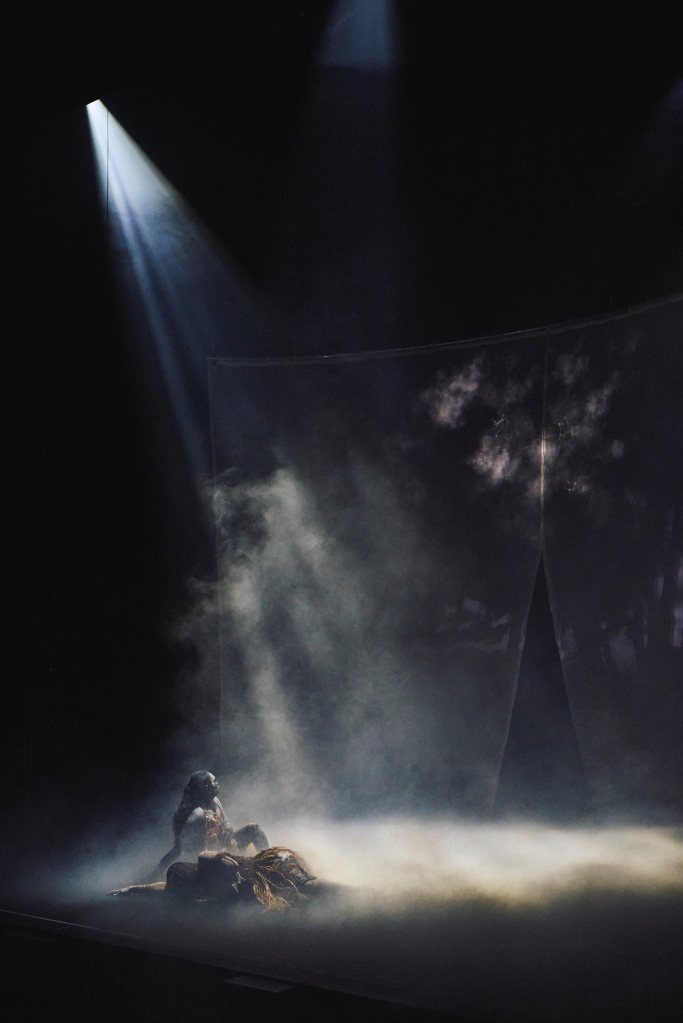
As a reviewer, it’s easy to go into a show with a degree of hubris, feeling generally equipped to be able to make sense of a performance and speak to it with confidence. After all, I have language, I have an adequate understanding of the elements that generally distinguish performance, and I am practiced at articulating my subjective experience in a way that generates interest in readers. But from the very beginning of this show, I was humbled as I realized that I did not have shared language with the performance, nor did I have shared stories, or a pre-existing understanding of the musical instruments, clothing and accessories, or performance styles that this show is built on. It quickly became evident that my job here was to experience this performance as an outsider to an established scene, and to begin the process of learning something new from scratch, just as the encounter between the two groups performing this piece was depicted as beginning a process of connection between two cultural giants, from scratch.
With humble acknowledgement of my limited comprehension, there were several powerful moments in the show that stood out for me. The early projections of land, sea, and mountains, which seemed to transport us to the home grounds of the cultures that were speaking to us. Costumes which depicted traditional qualities that aligned with the stories and places of origin at a deeply intuitive level. A powerful representation of a kangaroo hunt, with a remarkable use of physicality by the actor playing the kangaroo. The grounding and cleansing quality of synchronized movements in a piece depicting ocean life. The deeply resonant and powerful voice and presence of Seredau Tariyaljan, who commanded the stage with an indescribably wise elder energy. The traditional instruments, and the refreshingly authentic quality of the systems of sound they produced. Within the projections, fluid lines that transformed between varying degrees of squiggle, which seemed to correlate, in their abstractness, with the dynamic newness of the connections being forged between the two cultures and their art forms.
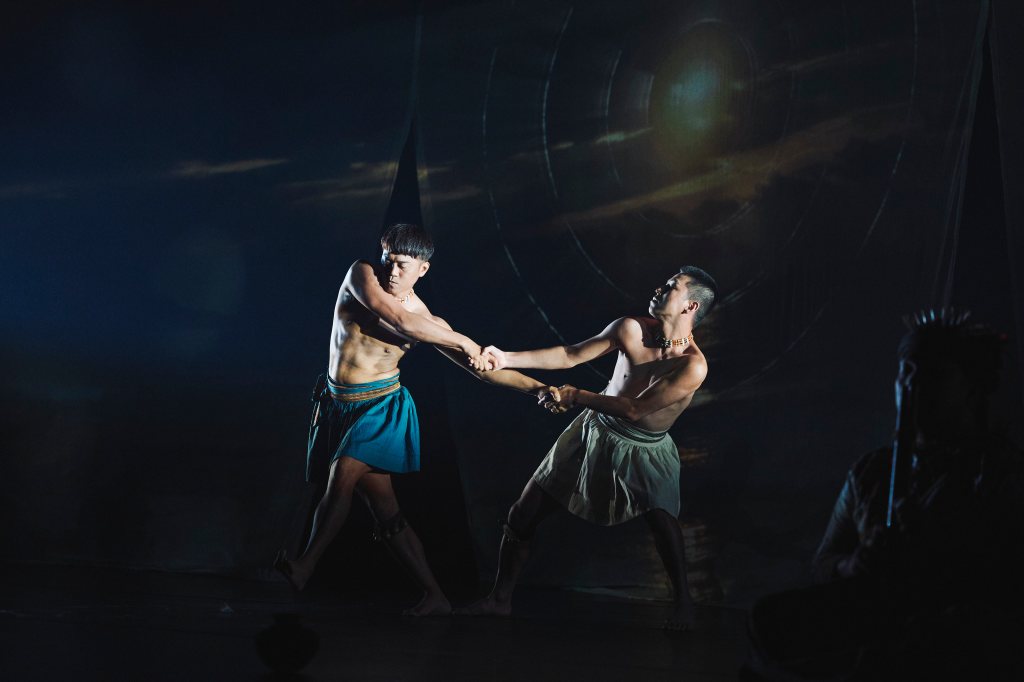
And then there was the deeply felt sense of community that rose to the fore. There was a visible and meaningful presence of elders leading the performances and cultural communications from both sides – there was an undeniable aura of respect around what they have inherited, what they are stewards of, what they pass on, and how. The connection between the performers of each group were beautiful to watch – in particular the two male dancers (pictured above) who moved together with breathtaking precision, with interlocked arms and synchronized steps, matching bands of bells strapped around one knee, mirroring emotional states of vigour and triumph and pure aliveness as they poured themselves into their dancing.
Towards the end, traditional mats were laid down to seat both groups in their own cultural styles, and a special circle – which seemed to depict containment and connection – was placed lovingly and collaboratively around the stage, and all the performers of both groups shared songs and movement freely with each other. They also drew in the audience through coordinated clapping, and there was a powerful sense of inclusion for us, that co-existed easily with my internal experience of being an outsider to those specific songs and movements. The exhilaration of what felt like forming a new connection that transcended language and stories, was palpable in the audience energy.
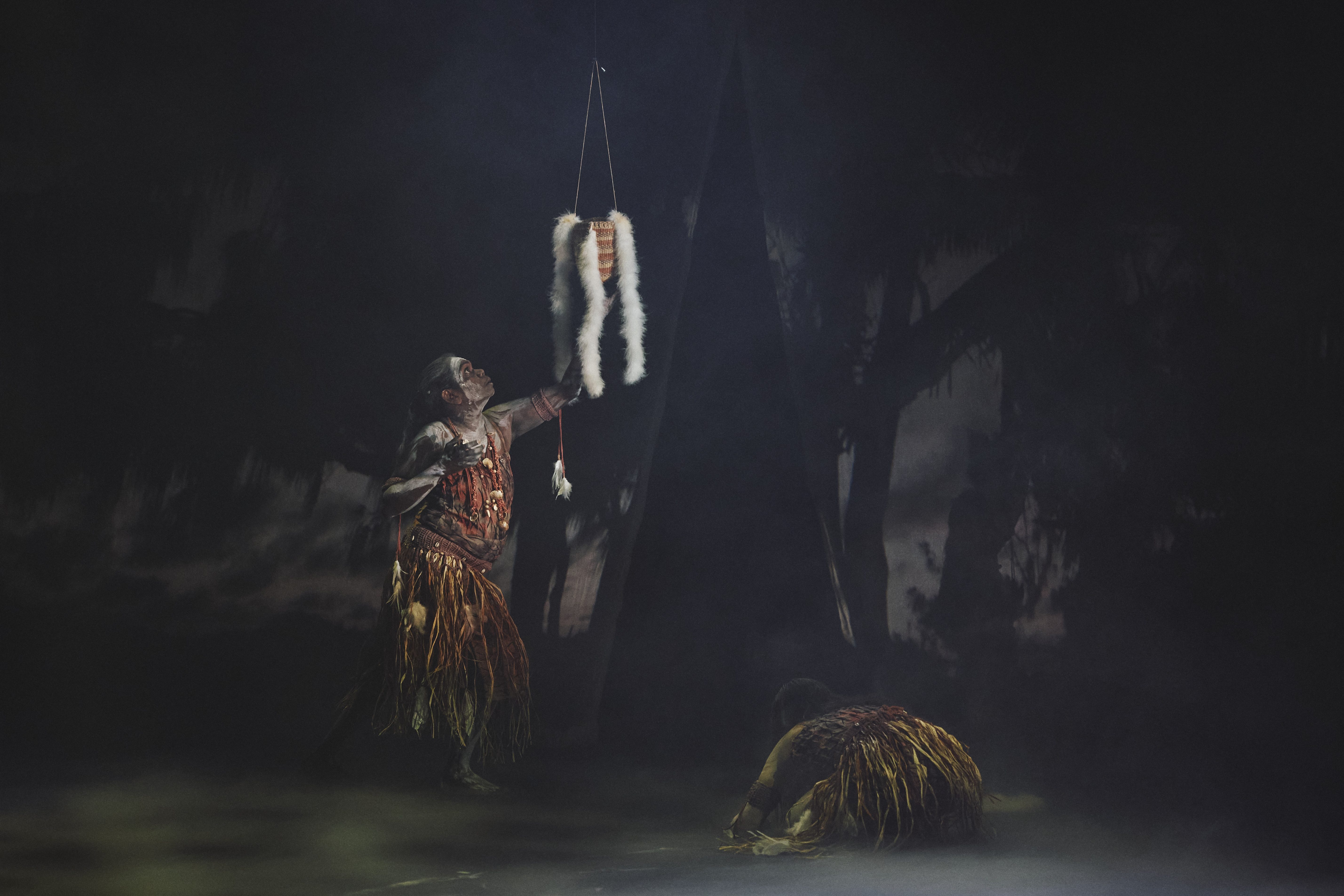

Gapu Ŋupan ignited in me a deep reverence for the slow work that goes into respectfully seeing and honouring what has gone into the building of a culture and the evolution of a community over an aggregation of many moments, days, months, years, decades, centuries, millennia — to bring into this present moment a beautiful cross-section of an impossibly complex and intricate fullness. To witness it in this moment, for an hour, is a fairly straightforward (if humbling) task, but to truly immerse oneself into its richness and significance would demand a sizeable volume of consistent, patient, and practiced returning, over and over again, to absorb what the various layers of the composition have to offer. Based on my experience of this show, I can wholeheartedly say that devoting any amount of space, time, and commitment to do this, would be well worth the effort.
 Jaya Berged